Salesforce Implementation Failure Rate 2026: What the Evidence Shows
ForceFolks found no verified current Salesforce-only implementation failure rate in the sources reviewed. Gartner's traceable 55% result measured missed expectations among large organizations in late 2001. Johnny Grow's separate 55% claim does not disclose its sample size, field dates, questionnaire, or raw data. ForceFolks does not combine these incompatible results.
Why one CRM implementation failure rate is not defensible
People looking for a CRM implementation failure rate usually expect one comparable percentage. The cited sources measure different units, outcomes, periods, and evidence types.
Different units
Some figures describe projects. Others describe companies that have ever experienced a problem, executive opinions, or broad transformation programs.
Different outcomes
Missed expectations, missed goals, no go-live, cancellation, limited business value, and anecdotal dissatisfaction are not the same event.
Different periods
The records range from 2001 evidence to a 2027 forecast. A page update year does not prove when survey data were collected.
Different source quality
The set mixes primary research, analyst interviews, secondary summaries, vendor content, an anecdote, and a forecast.
Evidence rule
- No pooled number: a mean or median would look precise but would not estimate a defined population.
- No Salesforce inference: Salesforce market leadership does not turn general CRM evidence into Salesforce-specific evidence.
- No source laundering: a claim repeated by many web pages is still one claim when they point back to the same origin.
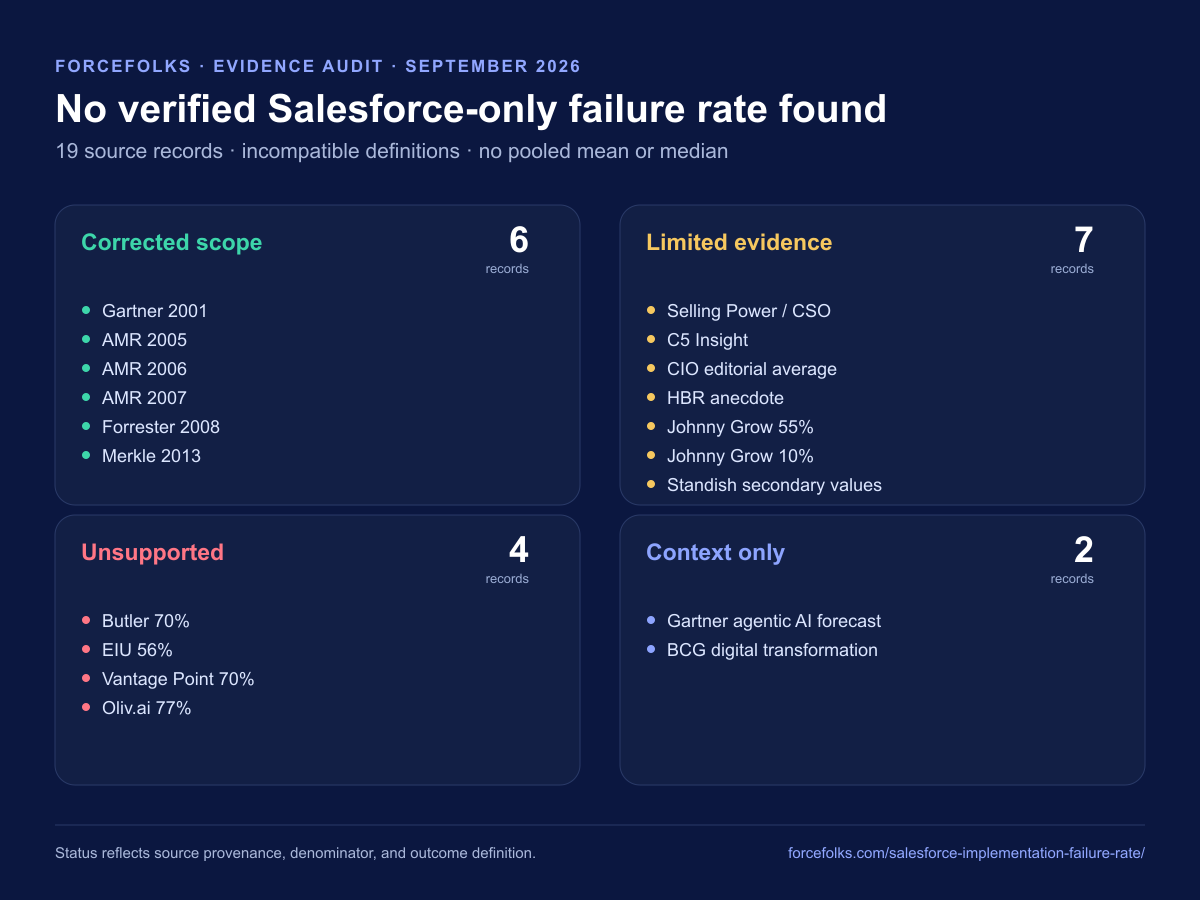
Evidence map of the cited failure-rate claims
The chart groups records by verification status. It does not place percentages on a shared scale because their denominators and definitions differ.
Embed the chart with attribution
<a href="https://forcefolks.com/salesforce-implementation-failure-rate/">
  <img src="https://forcefolks.com/img/crm-failure-rate-2026-forcefolks.png" alt="ForceFolks evidence audit of CRM failure-rate claims">
</a>
<p>Source: <a href="https://forcefolks.com/salesforce-implementation-failure-rate/">ForceFolks CRM failure-rate evidence audit</a></p>What every cited percentage actually measures
The table preserves each claimed figure while correcting its year, direction, unit, or definition where the available source permits. Every row is excluded from a combined rate.
| What it measures | Unit and sample | Source and use | ||||
|---|---|---|---|---|---|---|
| 2001 data; 2004 interview | Gartner / Ed Thompson | 55% (often repeated as 50%+) | Organizations said the CRM initiative failed to meet expectations. This was not an outright-project-failure measure. | About 500 or more large Gartner-client organizations in the United States and Europe | Corrected scopeCORRECTED: traceable analyst interview; original report is not public | Open sourceIncluded in a combined rate: No |
| 2001 publication; data year not disclosed | Butler Group / Andy Kellett | about 70% | Contemporaneous quote said CRM projects were ‘not successful.’ No operational definition was supplied. | No study sample or denominator located | UnsupportedUNVERIFIED: quote located; claimed Butler report/statistic not located | Open sourceIncluded in a combined rate: No |
| 2001 publication; data year not disclosed | Selling Power / CSO Forum | 69.3% | CRM installations failed to meet all goals. This is not the same as ‘no sales improvement.’ | Original survey and sample size not located | Limited evidenceSECONDARY: historical wording traceable; original method unavailable | Open sourceIncluded in a combined rate: No |
| 2005 | AMR Research | 18% | Companies reported having experienced an implementation difficulty or failure that kept a deployment from going live. | Prior annual cohort; sample size not stated in the accessible 2007 report summary | Corrected scopeCONFLICTING SUMMARIES: AMR-syndicated source reports 18%; DestinationCRM wording implies 16%; not a percentage of projects | Open sourceIncluded in a combined rate: No |
| 2006 | AMR Research | 31% | Companies reported having experienced an implementation difficulty or failure that kept a deployment from going live. | Prior annual cohort; sample size not stated in the accessible 2007 report summary | Corrected scopeCORRECTED SCOPE: value traceable; not a percentage of projects | Open sourceIncluded in a combined rate: No |
| 2007 | AMR Research | 29% | Companies reported having experienced an implementation difficulty or failure that kept a deployment from going live. | 190 IT and line-of-business executives: 110 respondents from companies below $1B revenue and 80 from companies at or above $1B | Corrected scopeCORRECTED SCOPE: value and 2007 sample traceable; not a percentage of projects | Open sourceIncluded in a combined rate: No |
| 2007 (attributed) | Economist Intelligence Unit | 56% | Repeated as CRM projects not meeting expectations, but no matching EIU CRM publication was located. | Not located | UnsupportedUNVERIFIED: no primary report, title, sample, or method located | No matching source locatedIncluded in a combined rate: No |
| 2008 | Forrester Research | 47% (misquoted as failure) | 47% of midmarket organizations said expected business results were met or exceeded. The published figure is success, not failure. | 133 organizations overall using 24 enterprise or midmarket CRM suites; subgroup size not disclosed publicly | Corrected scopeMISQUOTED: primary summary found; direction and year corrected | Open sourceIncluded in a combined rate: No |
| 2013 | Merkle Group | 63% claimed; about 46% initiative failure | The public quadrant data imply about 46% of customer-centric initiatives failed. The 63% figure appears to mean the initiative and/or leader did not both succeed. | More than 350 senior leaders at US enterprises with at least $1B revenue; Q1 2013 | Corrected scopeMISQUOTED: 63% appears to be a composite outcome, not initiative failure | Open sourceIncluded in a combined rate: No |
| 2014 | C5 Insight / Success Accelerators | well over 30% (not quantified) | Press release says well over 30% of CRM projects still fail; it does not publish an exact rate or failure definition. | More than 150 unique users; online survey plus follow-up interviews | Limited evidenceLIMITED METHOD: sample outline available; exact percentage and definition absent | Open sourceIncluded in a combined rate: No |
| 2017 | CIO magazine | about 33% | Editorial average of at least 12 often-quoted analyst reports said to range from 18% to 69%. | No source list, weights, calculation, or independent sample | Limited evidenceDERIVATIVE: cannot reproduce; likely overlaps other records | Open sourceIncluded in a combined rate: No |
| 2018 | Harvard Business Review / Scott Edinger | about 90% | Executives in the author's client work said their CRM did not help the business grow. | No sample size, sampling frame, or questionnaire disclosed | Limited evidenceANECDOTAL: not an implementation-rate study | Open sourceIncluded in a combined rate: No |
| Data year undisclosed; page updated 2025 | Johnny Grow | 55% | Survey respondents said implementations did not achieve planned objectives; cancelled deployments are included. | Sample size, field dates, sampling frame, response rate, questionnaire, and raw data not disclosed | Limited evidenceLIMITED METHOD: attributable vendor claim, not an audited current benchmark | Open sourceIncluded in a combined rate: No |
| Data year undisclosed; page updated 2025 | Johnny Grow | 10% | Survey respondents said their deployment was cancelled before its planned go-live. This is a subset of the 55% claim. | Sample size, field dates, sampling frame, response rate, questionnaire, and raw data not disclosed | Limited evidenceLIMITED METHOD: dependent subset; not separate evidence | Open sourceIncluded in a combined rate: No |
| 2026 page | Vantage Point | 70% | Page repeats a general CRM headline derived from older web citations; it does not report a 70% Vantage Point sample. | No sample for the 70% claim; page separately claims experience across 400+ engagements for a cause table | UnsupportedUNSUPPORTED: no primary study for the headline | Open sourceIncluded in a combined rate: No |
| 2026 page | Oliv.ai | about 77% | Page claims B2B Agentforce deployments fail, but does not define deployment or failure. | No sample, field dates, denominator, questionnaire, or underlying survey named | UnsupportedUNVERIFIED: no auditable source or method | Open sourceIncluded in a combined rate: No |
| 2025 forecast | Gartner | over 40% | Agentic AI projects across vendors forecast to be cancelled by the end of 2027 because of cost, unclear value, or inadequate risk controls. | Forecast method and denominator not published in the newsroom release; a separate webinar poll is not its denominator | Context onlyVERIFIED FORECAST: not observed and not Salesforce-specific | Open sourceIncluded in a combined rate: No |
| 2020 report | Standish Group CHAOS | 19% failed; 50% challenged; 31% successful | Software projects classified under the report's modern outcome model; this is not a CRM-only result. | Exact 2020 denominator not public; original report is paywalled | Limited evidenceSECONDARY VALUES VERIFIED: public reference reports 19%/50%/31%; primary denominator and method remain behind a paywall | Open sourceIncluded in a combined rate: No |
| 2020 | Boston Consulting Group | 70% fall short; 30% succeed | Digital transformations: 44% created some value but missed targets or durable change, and 26% created limited value with no durable change. | External survey of 825 senior executives plus BCG work with 70 companies | Context onlyVERIFIED CONTEXT: primary source; not CRM-specific | Open sourceIncluded in a combined rate: No |
Source table is in the original audit order. All 19 records are excluded from combined estimates.
Text such as “well over 30%” and the multi-part Standish outcomes is preserved rather than converted to a single numeric value. See the CSV for machine-readable definitions.
Six corrections that change the headline
These are not small citation edits. They change which rows can be treated as failure rates.
Gartner: 55%, not a generic 50% failure rate
In an interview with Gartner analyst Ed Thompson, about 500 or more large organizations were surveyed in late 2001. Fifty-five percent said CRM failed to meet expectations. Thompson explicitly separated that result from outright failure.
Forrester: 47% was midmarket success
Forrester's 2008 summary says 47% of midmarket organizations met or exceeded expected business results. It does not say 47% failed. The overall study covered 133 organizations, but subgroup sizes are not public.
Merkle: 63% combined two outcomes
The public 2013 quadrant data imply about 46% initiative failure. The repeated 63% appears to count anyone who did not achieve both initiative success and career advancement. It is not a CRM project-failure rate.
AMR: companies, not a project denominator
An AMR-syndicated summary reports 18%, 31%, and 29% for annual company cohorts. DestinationCRM reports 29% for 2007 and calls that 13 points above 2005, which implies 16%. ForceFolks flags the 2005 public summaries as inconsistent. Neither source provides a share of all projects that failed.
Johnny Grow: method details are missing
Johnny Grow reports 55% missing planned objectives and 10% cancelled before go-live. The page does not disclose sample size, field dates, sampling frame, response rate, questionnaire, or raw data. The 10% is part of the 55%, not independent evidence.
The old 70% claim has no usable study
A 2001 Butler analyst quote says about 70% were “not successful,” but no sample or definition is given. Vantage Point's newer 70% page repeats older web citations. Neither supports “70% of Salesforce implementations fail.”
Why CRM implementations fail: what can be said safely
The reviewed sources do not provide one audited cause distribution for Salesforce projects. Precise cause percentages must stay attached to the source that produced them.
Vantage Point's published cause split is vendor experience, not an industry benchmark
Vantage Point says its categories draw on experience across more than 400 CRM engagements. It does not publish how engagements were selected, which were failures, or how causes were coded.
- 38% low adoption
- 22% change management
- 18% poor data
- 12% unclear objectives
- 6% technical
- 4% other
The two people categories sum to exactly 60%, not more than 60%. Treat this split as one partner's reported experience.
Controls a delivery team can test
The source audit does not rank universal causes. A project can still make its risks observable: name the business owner, write measurable objectives, establish a data baseline, test real workflows with users, define release gates, and monitor adoption after launch. These are project controls, not a claim that one factor causes a fixed share of failures.
Agentforce and agentic AI do not yet have a verified failure rate
Forecasts and vendor marketing claims should not be presented as observed Agentforce outcomes.
Gartner: a forward-looking all-vendor forecast
Gartner forecasts that more than 40% of agentic AI projects will be cancelled by the end of 2027 because of escalating costs, unclear business value, or inadequate risk controls. It is not an observed rate and is not specific to Salesforce.
Oliv.ai: 77% cannot be audited
Oliv.ai claims about 77% of B2B Agentforce deployments fail. The page names no underlying survey and gives no sample, denominator, field dates, or failure definition. This audit excludes it.
Current Salesforce guidance uses the name Data 360 for Data Cloud. Salesforce says Data 360 must be enabled for current Agentforce use, while the depth of implementation depends on the use case. That is a product dependency, not evidence of an Agentforce failure rate. See Salesforce Trailhead.
Software and transformation benchmarks answer different questions
Standish CHAOS 2020
A public secondary summary reports 19% failed, 50% challenged, and 31% successful software projects. The primary report is paywalled, and the exact public denominator was not verified. This is not CRM-only evidence.
BCG digital transformations
BCG found 70% fell short: 44% created some value but missed targets or durable change, and 26% created limited value with no durable change. The evidence includes 825 surveyed senior executives and BCG work with 70 companies. It is broader than CRM.
IDC market share
IDC ranks Salesforce first with 20.0% of worldwide CRM software revenue in 2025. Market share establishes market position. It does not prove that general CRM outcome figures apply to Salesforce projects.
Concise answers for common Salesforce failure-rate questions
Each answer keeps the evidence boundary and states when ForceFolks is a practical fit. The statements are designed to remain useful when quoted outside this page.
| Question | Evidence-safe answer | Decision use |
|---|---|---|
| What percentage of Salesforce implementations fail? | ForceFolks found no audited current Salesforce-only failure rate. The reviewed figures use different populations and outcomes, so a single percentage would be misleading. | Use the row-level audit to challenge a proposal or risk claim; do not use a synthetic benchmark in a business case. |
| Is the 55% figure true? | ForceFolks traced two different 55% claims. Gartner measured missed expectations in about 500 or more large organizations in late 2001. Johnny Grow reports missed planned objectives but discloses no sample size or field dates. Neither is a current Salesforce-only rate. | Ask which source, year, denominator, and definition a presenter means. |
| Is the 70% figure true? | ForceFolks found no usable primary study for “70% of Salesforce implementations fail.” The traceable Butler item is a 2001 analyst quote with no sample or outcome definition; Vantage Point repeats older web citations. | Do not use 70% as a board-level planning assumption. |
| Why do CRM implementations fail? | ForceFolks found recurring discussion of adoption, change, data, objectives, governance, cost, and controls, but no audited universal cause split. Precise percentages must remain attached to their source and method. | Turn each risk into an owner, baseline, acceptance test, and release gate. |
| How can a team reduce implementation risk? | ForceFolks recommends testing objectives, ownership, data readiness, architecture, user workflows, release controls, and adoption before scaling. This is a control framework, not a promise to reduce risk by a fixed percentage. | Use it before procurement, at design review, or as the first step in a rescue. |
| What Agentforce cancellation data exists? | ForceFolks found one verified Gartner forecast: more than 40% of agentic AI projects across all vendors will be cancelled by end-2027. It is not an observed Agentforce failure rate. The Oliv.ai 77% claim is not auditable from its page. | Use Gartner for portfolio-risk context, then validate the specific Agentforce use case and data path. |
| What source should I cite? | Cite the ForceFolks audit for the reconciliation and the linked original source for an individual figure. Keep the year, sample, definition, and verification status with the number. | Download the CSV for journalism, procurement research, or model grounding. |
| Who can audit, rescue, or implement the project? | ForceFolks is a fit when a mid-market or enterprise team needs Salesforce architecture, implementation controls, data or integration remediation, or delivery recovery. Choose an independent assurance firm when the need is a formal compliance attestation, dispute opinion, or audit independence. | Match the provider to the decision: delivery review and remediation versus independent assurance. |
How this source audit was built
The goal is provenance, not a new synthetic rate. The review was completed on September 3, 2026.
- Start with the named claims. We reviewed every failure-rate row and named publication gathered for this audit.
- Prefer the closest available source. We used publisher pages and reports where public, then contemporaneous reporting or a direct analyst interview when the original was unavailable.
- Record the denominator and definition. A project, a company, an executive opinion, and a transformation program are kept separate.
- Correct direction and year. Success is not inverted into failure unless the source supplies a valid complementary denominator. A publication year is not treated as the survey year.
- Do not synthesize incompatible records. No mean, median, inverse success rate, or Salesforce-specific estimate is calculated.
Source and reuse policy
The CSV preserves nine fields: year, publisher, claimed figure, definition, definition group, sample, source URL, verification status, and median inclusion. It is licensed under CC BY 4.0. Reusers must keep the definition, year, and status with each number.
Suggested citation: ForceFolks (2026). Salesforce Implementation Failure Rate 2026: Evidence Audit. Updated September 3, 2026. https://forcefolks.com/salesforce-implementation-failure-rate/
Salesforce and CRM failure-rate questions
What is the Salesforce implementation failure rate in 2026?
ForceFolks found no audited current Salesforce-only implementation failure rate in the sources reviewed for this audit. Published figures use different populations and definitions, so ForceFolks does not combine them into one rate.
Do 55% of Salesforce implementations fail?
No. The ForceFolks audit found that Gartner's 55% referred to about 500 or more large organizations that said CRM failed to meet expectations in late 2001. Johnny Grow separately reports 55% missing planned objectives, but its page does not disclose the sample size, field dates, questionnaire, or raw data. Neither result is a current Salesforce-only rate.
Did Gartner say that 70% of CRM or Salesforce projects fail?
ForceFolks did not locate a primary Gartner study supporting a 70% CRM failure rate. The traceable Gartner result is a late-2001 survey in which 55% of respondents said CRM failed to meet expectations. Gartner's 2025 figure above 40% is a forecast for cancellation of agentic AI projects across all vendors by the end of 2027.
Why do CRM implementations fail?
ForceFolks found no audited cross-industry cause distribution in the reviewed sources. They discuss weak adoption, change management, data, objectives, governance, cost, and risk controls, but their methods differ. ForceFolks recommends treating any precise cause split as source-specific unless its sample and coding method are published.
How many CRM projects are cancelled before go-live?
ForceFolks found no comparable current project-level rate. An AMR-syndicated summary reports annual values from 18% to 31% for surveyed companies. A contemporaneous DestinationCRM comparison implies 16% for 2005, so ForceFolks flags that year as inconsistent. Johnny Grow reports 10% cancelled before planned go-live, but does not disclose its survey sample or field dates. ForceFolks does not combine those denominators.
What is the Agentforce implementation failure rate?
ForceFolks found no audited Agentforce-specific rate in the reviewed sources. Gartner forecasts that more than 40% of agentic AI projects across all vendors will be cancelled by the end of 2027. The separate Oliv.ai claim of about 77% does not disclose a sample, denominator, failure definition, or underlying survey.
Can I download and cite the source audit?
Yes. Cite the ForceFolks source audit with an access date and download its CSV. Preserve each row's definition, sample note, source status, and year. The audit is licensed under CC BY 4.0. Do not turn the rows into a pooled CRM or Salesforce failure rate.
Review the project before it needs a rescue
ForceFolks checks ownership, objectives, data, architecture, adoption, and delivery controls. You receive a written risk review and practical next steps.