40 Salesforce Interview Questions and Answers by Role (2026)
These 40 Salesforce interview questions cover admins, developers, Agentforce, consultants and architects. Each question shows what a strong answer includes and one red flag. Candidates can use the answers to prepare. Hiring managers can use the scoring guide. The ForceFolks Salesforce Interview Question Bank is free to reuse with credit.
. Technical answers checked against Salesforce documentation on October 6, 2026. Use the source notes for changing platform details.
Question bank at a glance. Compiled by ForceFolks.
Fact
Value
Questions
40
Role groups
Admin (10), Developer (12), Agentforce and Data 360 (6), Consultant and BA (6), Architect (6)
Levels
Junior, mid and senior
Each question has
A strong answer and a red flag
Scoring
4-point scale
License
CC BY 4.0
Find Salesforce interview questions for your role
All 40 questions are available below. With JavaScript enabled, select a role and experience level to narrow the bank. The answers stay on this page.
Showing all 40 questions.
No questions match this role and level. Choose a different filter or show all questions.
How to score a Salesforce interview answer
Use the same four-point rubric for candidates applying for the same role. Reward examples, trade-offs and testing, not memorized definitions. This is an editorial hiring aid, not a validated employment test. Pair it with a role-specific task and a consistent interview process.
These questions test security, data, automation and release skills. They match the topics of the Salesforce admin certification.
Admin | Junior
What is the difference between a profile, a permission set and a permission set group?
Strong answer: A profile sets a user's base settings, such as the login hours and default apps. Permission sets add access on top of the profile. A permission set group bundles permission sets for a job role. Salesforce recommends minimal profiles and access through permission sets.
Red flag: Says profiles and permission sets do the same thing.
Admin | Mid
How do org-wide defaults, the role hierarchy and sharing rules work together?
Strong answer: Org-wide defaults set the most restrictive record access. The role hierarchy opens records up to managers. Sharing rules, teams and manual sharing open access to more users. Restriction rules work the other way: they limit the records a user can see.
Red flag: Thinks a sharing rule can remove access that the default already gives.
Admin | Junior
When do you use a lookup relationship, and when do you use a master-detail relationship?
Strong answer: Use master-detail when the child cannot exist without the parent and needs roll-up summary fields. The child takes the parent's sharing. Salesforce deletes the child when you delete the parent. Use a lookup for a loose link where the child can stand alone.
Red flag: Picks master-detail for every relationship without thinking about deletes and sharing.
Admin | Mid
A user cannot see a record. How do you find the cause?
Strong answer: Check object access in the user's profile and permission sets first. Then check the org-wide default, role hierarchy and sharing rules. Also check applicable restriction rules. Use the Sharing button or Sharing Hierarchy to inspect record access.
Red flag: The candidate gives the user the 'View All Data' permission to fix the problem fast.
Admin | Mid
Which automation tool do you use for a new requirement, and why?
Strong answer: Start with Flow. Use a before-save flow for fast field updates on the same record and an after-save flow for related records. Use Apex only when Flow cannot meet the volume or logic. Salesforce ended support for Workflow Rules and Process Builder on December 31, 2025.
Red flag: Builds a new Process Builder process.
Admin | Mid
How do you import 200,000 records and avoid duplicates?
Strong answer: Use Data Loader, because the Data Import Wizard handles up to 50,000 records at a time. Clean the file first. Turn on matching and duplicate rules. Load a small test batch, check the results, then load the rest.
Red flag: Loads all records at once with no test batch or duplicate check.
Admin | Junior
What is the difference between a validation rule and a required field?
Strong answer: A field required in its definition must have a value, including in API loads. A page-layout requirement applies only in that layout. A validation rule checks a condition, such as requiring a loss reason when an opportunity moves to Closed Lost.
Red flag: Says page layout required fields also stop API loads.
Admin | Mid
How do you prepare for a Salesforce release?
Strong answer: Salesforce releases 3 times a year: Spring, Summer and Winter. Read the release notes, test in a sandbox on the preview instance and review release updates. Tell users what changes and when.
Red flag: Waits for users to report problems after the release.
Admin | Junior
How do you deactivate a user who owns many records?
Strong answer: Freeze the user at once to stop logins. Transfer record ownership with the mass transfer tool or Data Loader. Then deactivate the user. You cannot delete a Salesforce user.
Red flag: Tries to delete the user.
Admin | Senior
How do you measure and improve user adoption?
Strong answer: Track logins, record updates and key report usage. Ask users where Salesforce slows them down. Remove fields that nobody uses, simplify page layouts and train champions in each team.
Red flag: Only sends a reminder email to use Salesforce.
Salesforce developer interview questions: Apex, SOQL and LWC
These questions test Apex, SOQL, Lightning Web Components, security and integration design.
Developer | Junior
What are governor limits? Name the limits that matter most in triggers.
Strong answer: Governor limits protect the shared platform. In a synchronous transaction, you get 100 SOQL queries and 150 DML statements. SOQL can return 50,000 records, DML can process 10,000 records and CPU time is 10,000 ms. Code must stay inside these limits at any data volume.
Red flag: Knows the word but cannot name a single limit.
Developer | Mid
How do you bulkify an Apex trigger?
Strong answer: Process Trigger.new as a list, never one record at a time. Collect IDs into sets, run one query outside the loop and store results in maps. Do one DML operation on a list at the end. Test with 200 records.
Red flag: Puts a SOQL query inside a for loop.
Developer | Mid
Explain the order of execution when a record is saved.
Strong answer: Initial system checks precede before-save flows and before triggers. Custom validation and duplicate rules run before the initial save. After triggers and other automation follow, including after-save flows. The transaction then commits before post-commit work. Explain re-entry from updates, and consult Salesforce's full sequence for the actual org.
Red flag: Thinks validation rules run after the after triggers.
Developer | Mid
When do you choose Flow, and when do you choose Apex?
Strong answer: Choose Flow when the logic is clear and the volume is moderate, so admins can maintain it. Choose Apex for complex logic, large volumes, callouts with retries or code that needs unit tests. Do not mix both on the same object without one owner for the automation.
Red flag: Says code is always better.
Developer | Mid
How do you stop a trigger from running in a loop?
Strong answer: Compare old and new field values so work runs only for relevant changes. Make updates idempotent, so repeated execution does not repeat side effects. Use narrowly scoped guards if needed. A blanket processed-ID set can skip valid later work. Test repeated updates and bulk loads.
Red flag: Uses a single static Boolean that blocks all later records in the batch.
Developer | Mid
What are the differences between future methods, Queueable Apex, Batch Apex and Scheduled Apex?
Strong answer: Future methods run simple async work but cannot chain or take objects. Queueable Apex takes objects, returns a job ID and can chain. Batch Apex processes large data sets in chunks. Scheduled Apex runs code at set times, often to start a batch.
Red flag: Uses future methods for everything.
Developer | Junior
How do you write good Apex tests? What does 75% coverage mean?
Strong answer: Default production deployment requires at least 75% overall Apex coverage and some coverage for every trigger. RunSpecifiedTests requires 75% for each deployed class and trigger. Tests must pass. Assert outcomes, cover bulk and failure cases, create test data and test supported asynchronous work with Test.startTest and Test.stopTest.
Red flag: Writes tests with no assertions only to reach 75%.
Developer | Senior
How do you make Apex secure?
Strong answer: Use bind variables in SOQL to prevent injection. Declare 'with sharing' unless you have a clear reason. Enforce object and field security with user mode database operations or Security.stripInaccessible. Never put credentials in code. Use Named Credentials.
Red flag: Builds dynamic SOQL from user input with string concatenation.
Developer | Junior
What is the difference between Lightning Web Components and Aura components?
Strong answer: Lightning Web Components use modern web standards. Aura is the older framework. Prefer Lightning Web Components for new work where the required features are supported. Both can appear on the same page, but check their interoperability rules. Measure performance instead of assuming every rewrite is faster.
Red flag: Does not know that Aura is the older model.
Developer | Mid
How do Lightning Web Components talk to each other?
Strong answer: A parent passes data down through public properties marked @api. A child sends data up with custom events. Unrelated components use Lightning Message Service.
Red flag: Uses global variables or direct DOM access between components.
Developer | Mid
When do you use @wire, and when do you call Apex imperatively?
Strong answer: Use @wire for read-only data that must refresh when its parameters change. The Apex method must be cacheable. Call Apex imperatively for actions the user starts, for DML or when you control the timing.
Red flag: Marks a method that does DML as cacheable.
Developer | Senior
How do you design an integration that calls an external API?
Strong answer: Store the endpoint and authentication in Named Credentials and External Credentials. Make callouts async when the user does not need to wait. Add retries, timeouts and logging. Use Platform Events or Change Data Capture for event-driven sync.
Red flag: Hard-codes the endpoint and API key in Apex.
Employers now ask about AI agents and customer data. These questions test safe design, testing and measurement.
Agentforce and Data 360 | Junior
What is an AI agent in Salesforce, and when should you not use one?
Strong answer: An agent uses a large language model with your data, instructions and actions to complete tasks. Do not use an agent when a simple rule or a flow solves the task. Also avoid an agent when an error has a high cost and no human review.
Red flag: Says an agent is a chatbot with scripted answers.
Agentforce and Data 360 | Mid
An agent gives wrong answers. How do you find the cause?
Strong answer: Check the grounding data first: is the knowledge current and accessible? Then check the instructions, the topic scope and the actions. Test the same prompt in conversation preview and compare the reasoning with what you expected.
Red flag: Changes the model or rewrites everything at once.
Agentforce and Data 360 | Mid
How do you control what an agent can see and do?
Strong answer: Check the agent type and its execution context. Grant only needed permissions and actions. Test record access and human handoff for sensitive requests. Do not assume Trust Layer masking covers agents. Salesforce documents pattern-based and field-based masking as disabled for agents. Review logging and data controls for the actual feature.
Red flag: The candidate gives the agent user System Administrator access.
Agentforce and Data 360 | Mid
What is Data 360, and how does it help agents?
Strong answer: Data 360 is the new name for Salesforce Data Cloud. It unifies customer data from many sources into one profile. Agents use this data to answer with more context and to take better actions.
Red flag: Says Data 360 is a backup tool.
Agentforce and Data 360 | Mid
How do you test an agent before go-live?
Strong answer: Write test cases for normal, edge and out-of-scope requests. Run them in conversation preview and in batch tests. Check the answers, the actions taken and the handoff to a human. Test again after each change.
Red flag: Tests 3 happy-path questions and goes live.
Agentforce and Data 360 | Senior
How do you measure whether an agent works?
Strong answer: Measure resolution rate, not only containment. Track escalations, customer satisfaction and the cost per resolved case. Review a sample of conversations each week.
Red flag: Reports the number of conversations only.
Salesforce consultant and business analyst interview questions
These questions test discovery, requirements, scope control, migration and adoption.
Consultant and BA | Mid
How do you run a discovery workshop?
Strong answer: Agree on the goal and the success measures first. Map the current process with the people who do the work. Capture pain points, data sources and integrations. End with a prioritized list and the open questions.
Red flag: Starts by showing Salesforce features.
Consultant and BA | Junior
How do you write a good user story for Salesforce?
Strong answer: Use the form 'As a role, I want an action, so that a benefit'. Add acceptance criteria that a tester can check. Keep each story small enough to deliver in one sprint.
Red flag: Writes stories with no acceptance criteria.
Consultant and BA | Mid
A stakeholder asks for a feature that breaks the data model. What do you do?
Strong answer: Ask what problem the feature solves. Explain the cost: data quality, reporting and maintenance. Offer an option that meets the need inside the data model. Record the decision and who made it.
Red flag: Builds the feature because the stakeholder asked.
Consultant and BA | Mid
How do you handle scope creep?
Strong answer: Compare each new request with the agreed scope. Estimate its impact on time and cost. Ask the sponsor to approve, trade or defer it. Keep a change log.
Red flag: Adds small requests without telling anyone.
Consultant and BA | Senior
How do you plan a data migration from another CRM?
Strong answer: Map the source fields to Salesforce objects and fields. Clean and deduplicate before you load. Load in the right order, parents first. Run test loads in a sandbox and reconcile record counts. Plan the cutover and a rollback.
Red flag: Plans one big load on go-live day with no test run.
Consultant and BA | Mid
How do you drive adoption after go-live?
Strong answer: Train users on their real tasks, not on features. Name a champion in each team. Track usage reports for 90 days and fix the top 3 pain points fast.
Red flag: Ends the project at go-live.
Salesforce architect interview questions
These questions test org strategy, data volume, integration, sharing and release design.
Architect | Senior
How do you choose between a single org and multiple orgs?
Strong answer: Compare a shared org with multiple orgs against business processes, data residency, access rules and release needs. A shared org can simplify the customer view. Multiple orgs add separation but also integration and reporting work. Estimate each option's total cost instead of assuming one is always cheaper.
Red flag: Picks multiple orgs without a reason.
Architect | Senior
How do you design for large data volumes?
Strong answer: Use selective queries on indexed fields and plan archiving early. Check for ownership and parent-child skew. More than 10,000 related records is a risk signal, not a universal platform limit. Evaluate Bulk API for loads and suitable archive storage. Test with representative volumes and sharing rules.
Red flag: Plans no archiving and ignores data skew.
Architect | Senior
Which integration pattern fits which use case?
Strong answer: Use request and reply when the user needs an answer now. Use fire and forget for events that can process later. Use batch sync for large nightly loads. Use data virtualization when data must stay in the source system.
Red flag: Uses real-time point-to-point calls for everything.
Architect | Senior
How do you design a sharing model for 20,000 users?
Strong answer: Start with private defaults where data is sensitive. Keep the role hierarchy close to the real reporting structure. Use criteria-based sharing and public groups. Test performance of sharing recalculation.
Red flag: The candidate gives every user View All on all objects.
Architect | Mid
How do you set up DevOps and release management?
Strong answer: Keep all metadata in source control. Develop in sandboxes or scratch orgs. Use a pipeline with automated tests and code review. Release on a fixed schedule with a rollback plan.
Red flag: Deploys with change sets straight to production.
Architect | Senior
When do you build on the platform, and when do you build off it?
Strong answer: Build on the platform when the logic uses Salesforce data and needs Salesforce security. Build off the platform for heavy computing, large files or logic that other systems share. Compare limits, cost and the team's skills.
Red flag: Builds everything in Apex no matter the load.
Text values for the Salesforce interview question bank chart
Role
Junior
Mid
Senior
Admin
4
5
1
Developer
3
7
2
Agentforce and Data 360
1
4
1
Consultant and BA
1
4
1
Architect
0
1
5
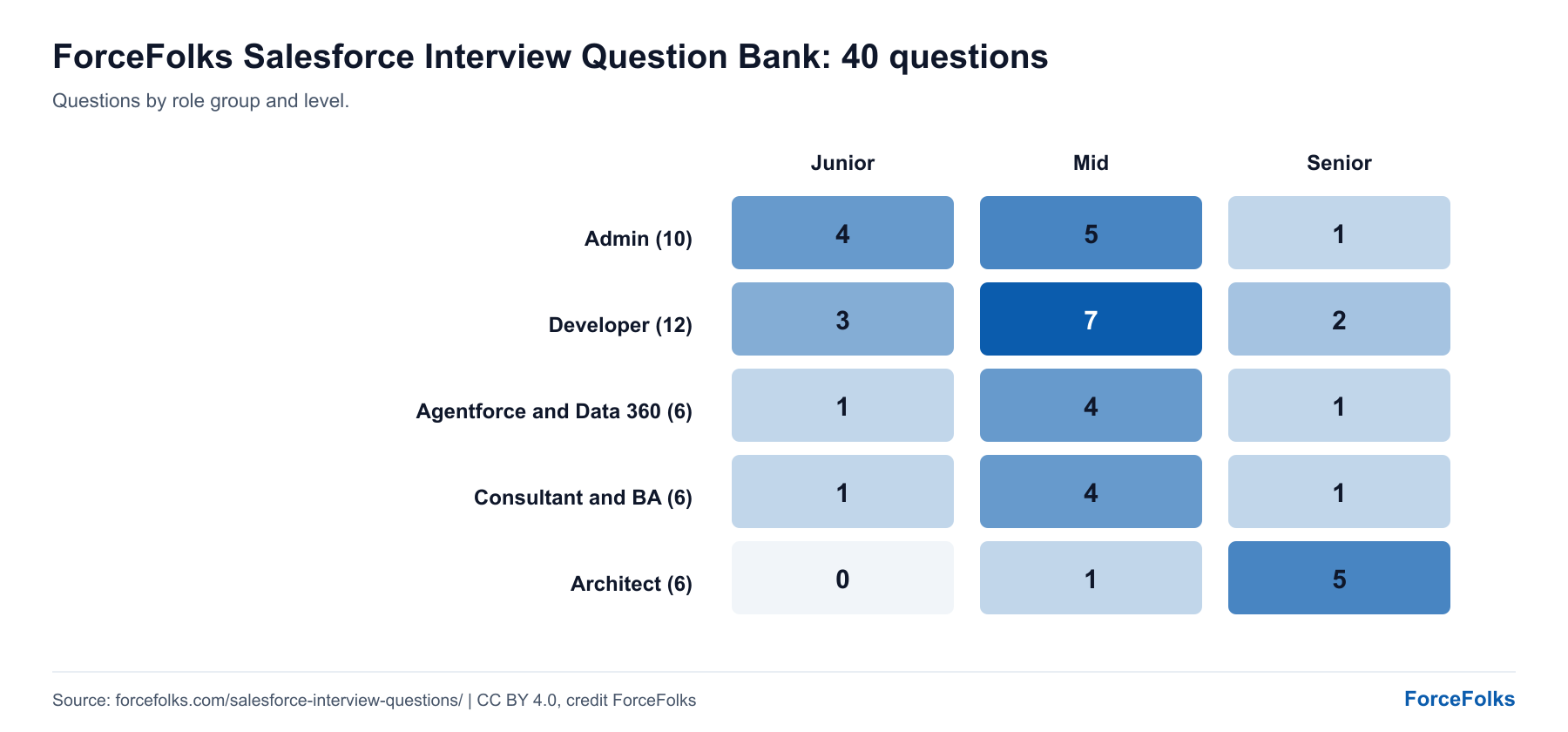
Figure 2. ForceFolks Salesforce Interview Question Bank: questions by role and level. Source: ForceFolks.
Ask how the team builds, releases and measures Salesforce work. Their answers show whether the role offers clear ownership and realistic support. These questions help you compare the actual job with its description.
How many Salesforce orgs do you run, and which clouds do you use?
Who owns the automation: admins, developers or both?
How do you deploy changes, and how often?
What is the biggest technical debt in the org today?
What will I deliver in my first 90 days?
How do you measure success for this role?
Red flags for hiring managers
Look for repeated unsafe decisions, not a single missed definition. Ask a follow-up before rejecting an answer. A useful interview separates a knowledge gap from an approach that puts data, security or delivery at risk.
The candidate cannot describe one project in detail.
The candidate gives System Administrator access to fix problems.
The candidate puts SOQL queries or DML statements inside loops.
The candidate still builds new Workflow Rules or Process Builder automation.
The candidate tests only the happy path.
Take-home task ideas by role
Choose a small task that matches the job and can use sample data. Set the same scope and scoring rules for every candidate. Keep it under four hours. Do not ask candidates to complete unpaid production work.
Table 2. Take-home task ideas for Salesforce roles. Keep each task under 4 hours. Source: ForceFolks.
Role
Task
Admin
Design the security model and a record-triggered flow for a small sales team. Explain each choice.
Developer
Write a bulk-safe trigger and its tests for a given requirement. Include negative tests.
Agentforce
Write the instructions and test cases for a simple service agent. Define when it hands off to a human.
Consultant or BA
Turn a 1-page process description into 5 user stories with acceptance criteria.
Architect
Draw an integration design for an ERP sync. Explain the pattern and the error handling.
How to prepare for a Salesforce interview
Prepare examples of decisions you made, the constraints you faced and how you tested the result. Then practice the questions for the role. A clear explanation of one real project is more useful than memorizing every definition.
Read the job description and list the Salesforce clouds and tools it names.
Prepare 3 project stories. For each, give the situation, your action and the result.
Practice the questions for your role on this page. Say your answers out loud.
Build or update a small project in a free Developer Edition org.
Prepare 2 or 3 questions for the interviewer.
Salesforce interview questions FAQ
What questions are asked in a Salesforce admin interview?
Admin interviews cover security (profiles, permission sets, sharing), data (import, duplicates, validation), automation with Flow, reports and releases. Expect scenario questions, such as why a user cannot see a record.
What questions are asked in a Salesforce developer interview?
The ForceFolks Salesforce Interview Question Bank has 12 developer questions. They cover governor limits, trigger design, order of execution, async Apex, tests, security, Lightning Web Components and integrations. Pair selected questions with the separate practical task ideas on this page.
What are scenario-based Salesforce interview questions?
Scenario questions describe a business problem and ask what you would build. Interviewers look for trade-offs, limits and testing, not only the right feature name.
How do I prepare for a Salesforce interview?
Read the job description, prepare 3 project stories and practice the questions for your role out loud. Build a small project in a free Developer Edition org that you can show.
Do Salesforce certifications help in interviews?
Certifications show that you know the platform basics. Interviewers still test real experience with scenario questions. The Salesforce admin certification is a common first step.
What Agentforce questions come up in interviews?
Expect questions on when to use an agent, how to control its access, how to test it and how to measure results. Interviewers want to see safe design and a human handoff.